A Curated Community of Women Leaders
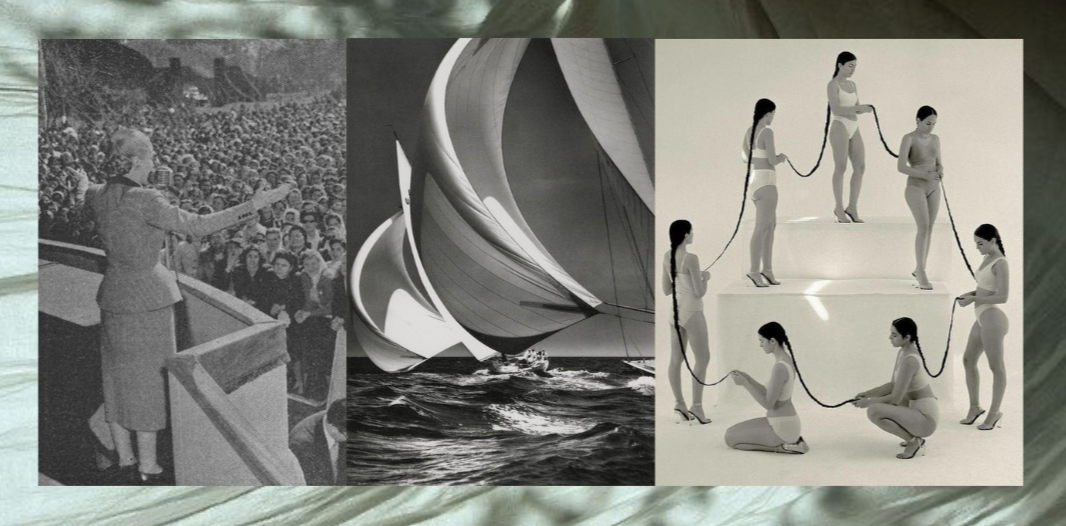
Designing a space where women can arrive with all of who they are, not with their titles.
Client: A global membership community
Year: 2021–2022
Region: Europe, Middle East, North Africa
My role: Lead service designer and researcher
Methods: Desk research and benchmarking, expert and member interviews, affinity mapping, Jobs to Be Done, value proposition design, co-creation workshops, service and experience design
At a glance: 170+ networks researched, 100+ off-the-record conversations, and a framework that shaped the brand, the membership journey and the launch experiences.
Challenge
How might we design a curated, high-level membership space for the most influential and impactful women, who seek expansion in their professional lives and beyond?
The founder's hypothesis was that highly accomplished women lack a safe, expansive space to be among equals: somewhere beyond the world of facades, where they can be as they are and still access resources for their growth. Our job was to test that hypothesis with the women themselves, and turn what we learned into the community's value proposition, experience pillars and first member journey.
Approach
We ran research and development over roughly 12–15 weeks, moving from a shared vision to evidence to a launchable experience.
A vision kickoff. A four-hour virtual workshop with the founding team covering who we were designing for, why the world needs this now, and what it should feel like. The founder's own story became the starting point: start with your own need, or the community becomes hollow.
Desk research and benchmarking. We researched 170+ networks, collectives, membership models and loyalty programs, analyzed 33 in depth, and wrote 5 detailed case studies (from Chief and YPO to regional networks in the Gulf, Africa and India). We compared membership criteria, experience and pricing to find the white space.
Expert interviews. We spoke with specialists in community building, women's psychology, body-mind therapy, experience design and indigenous knowledge, to design with the best of new and ancient practice.
Member interviews. Long-form conversations with founding-member candidates (founders, CEOs, investors and board directors across Europe, the Gulf and Africa) about where they started, where they are now, how they got there and where they want to go.
Synthesis. Every interview was coded into habits, quotes, needs and pain points, motivations and early insights, then clustered on an affinity board into themes and mega-themes.
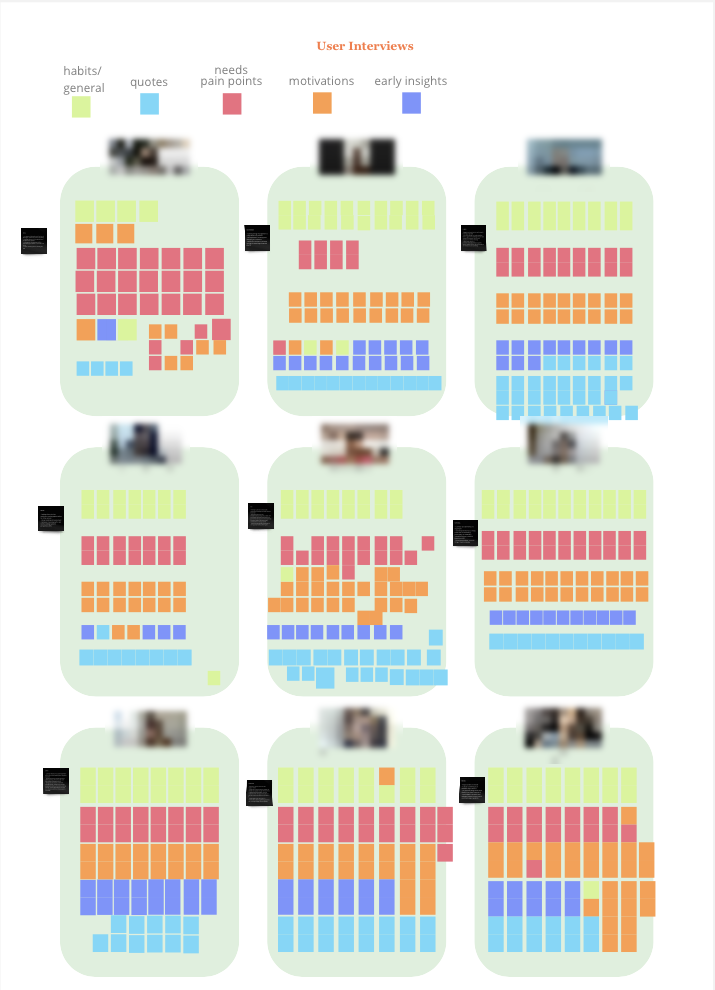
User interview board coded by habits, quotes, needs, motivations and early insights.
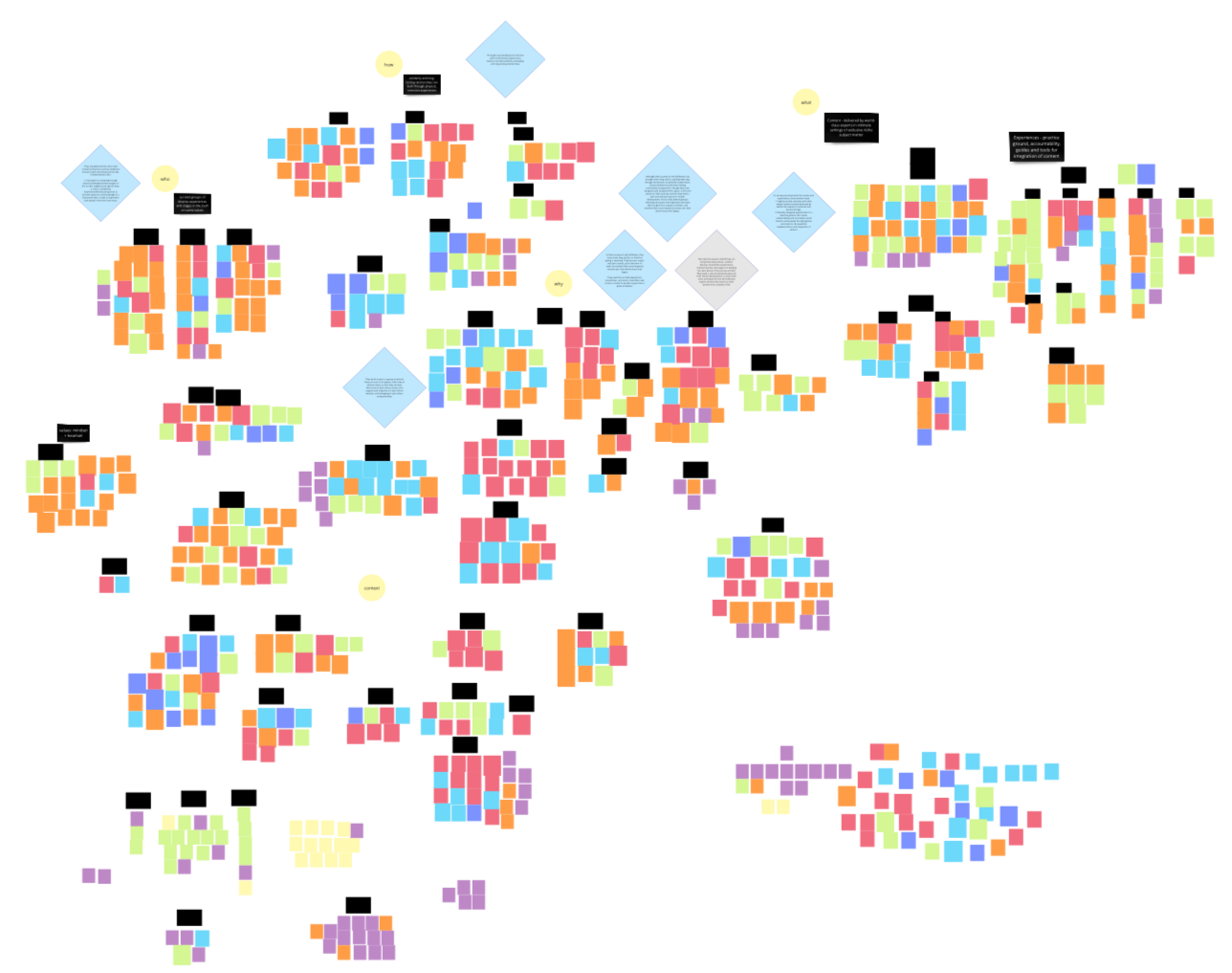
Affinity board combining all research findings, insights, emerging themes.
Key Insight
Plenty of networks offered these women mentorship and connections. None met them where they actually were:
They had worked their way through the binaries of work and life, leader and mother, mentor and mentee, and come out feeling consistently unsupported. They needed a space where they could arrive with all of who they are, not with titles.
In their own words:
“The air gets thinner as you advance. You have fewer and fewer reference points. Fewer and fewer women to exchange with."
"Mentoring is not selfless. There is no mentor and mentee. The interconnectedness, the reciprocity, fulfils me."
"I am not the type to pour my heart out to people I don't know. I want to meet people face to face and develop a connection over time."
Other patterns we kept hearing: trust is built in person and slowly; food and cooking together strip away the layers; learning only matters when it can be applied to your own context; and impact is personal legacy.
The Mandorla Framework
A mandorla is the almond shape where two circles overlap. The women we spoke with were constantly asked to choose: strong or soft, personal or professional, local or global. Inspired by Jungian psychology where the mandorla holds our opposing truths together instead of compromising between them. I built this framework to stop treating these as trade-offs, and to design for the intersection: the field where polarities coexist.
We mapped 12 polarities from the research. The team then voted on which intersections should define the community's values and experiences.
The framework became the backbone of the brand's values (built on the transformative power of holding ambiguity), its tone of voice, and the criteria we used to judge every experience idea.
From insight to service
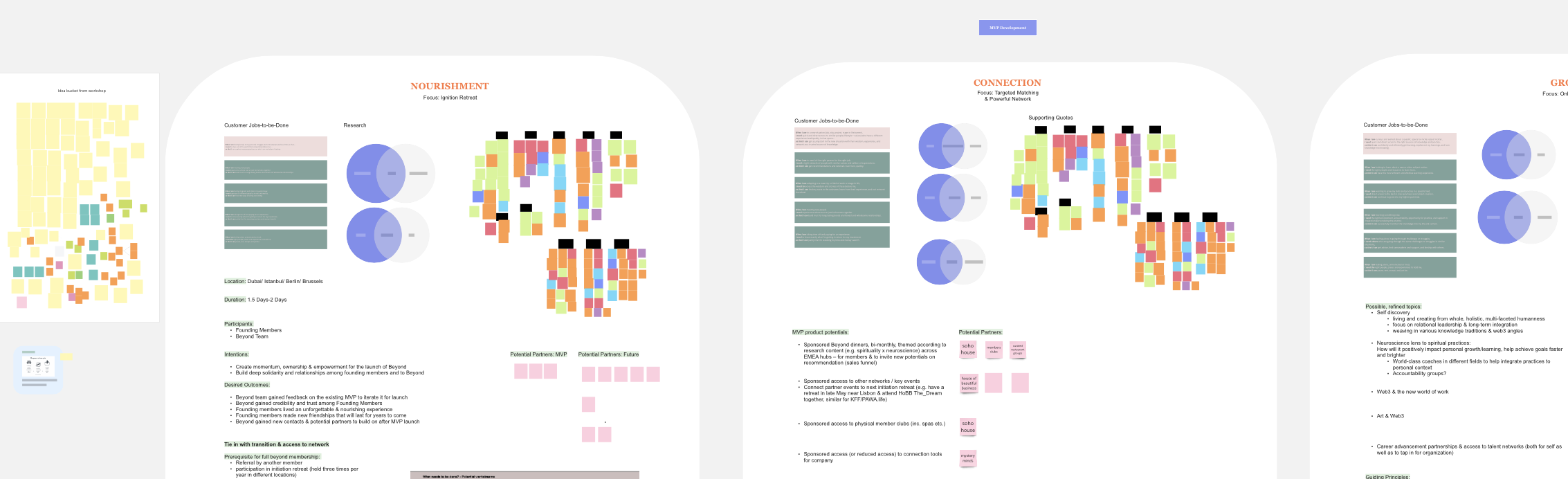
I translated the themes into Jobs-to-Be-Done: When I am… I need… so that I can… Clustering and ranking the jobs gave us four guiding service pillars, each with one main need:
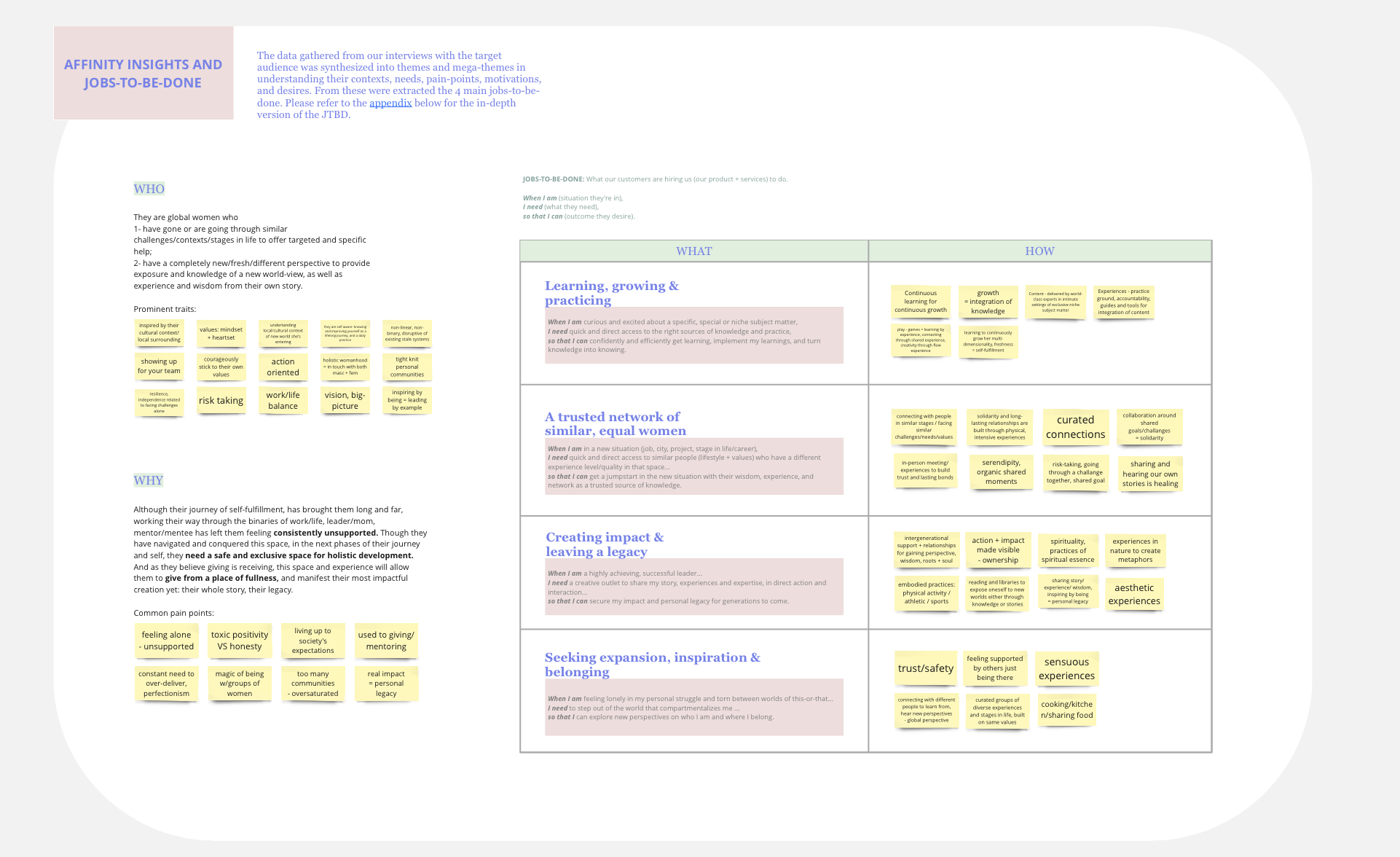
Connection: When I am in a new job, city or stage of life, I need quick, direct access to people with shared values and different experience, so that I can get a jumpstart from their wisdom and network.
Growth: When I am curious about a specific or niche subject, I need direct access to the right sources of knowledge and practice, so that I can turn knowledge into knowing.
Nourishment: When I am feeling lonely and torn between worlds of this-or-that, I need to step out of the world that compartmentalizes me, so that I can explore who I am and where I belong.
Impact: When I am a highly accomplished leader, I need a creative outlet to share my story and expertise through direct action, so that I can secure my legacy for generations to come.
Each pillar was then checked against the market analysis, to see where existing networks already served the need and where the white space was.
Co-creating with founding members
We didn't want to design the community for its members; we wanted to design it with them. In a co-creation session, founding members placed themselves on a Minimum Viable Community canvas, voting on the tensions every community has to resolve:
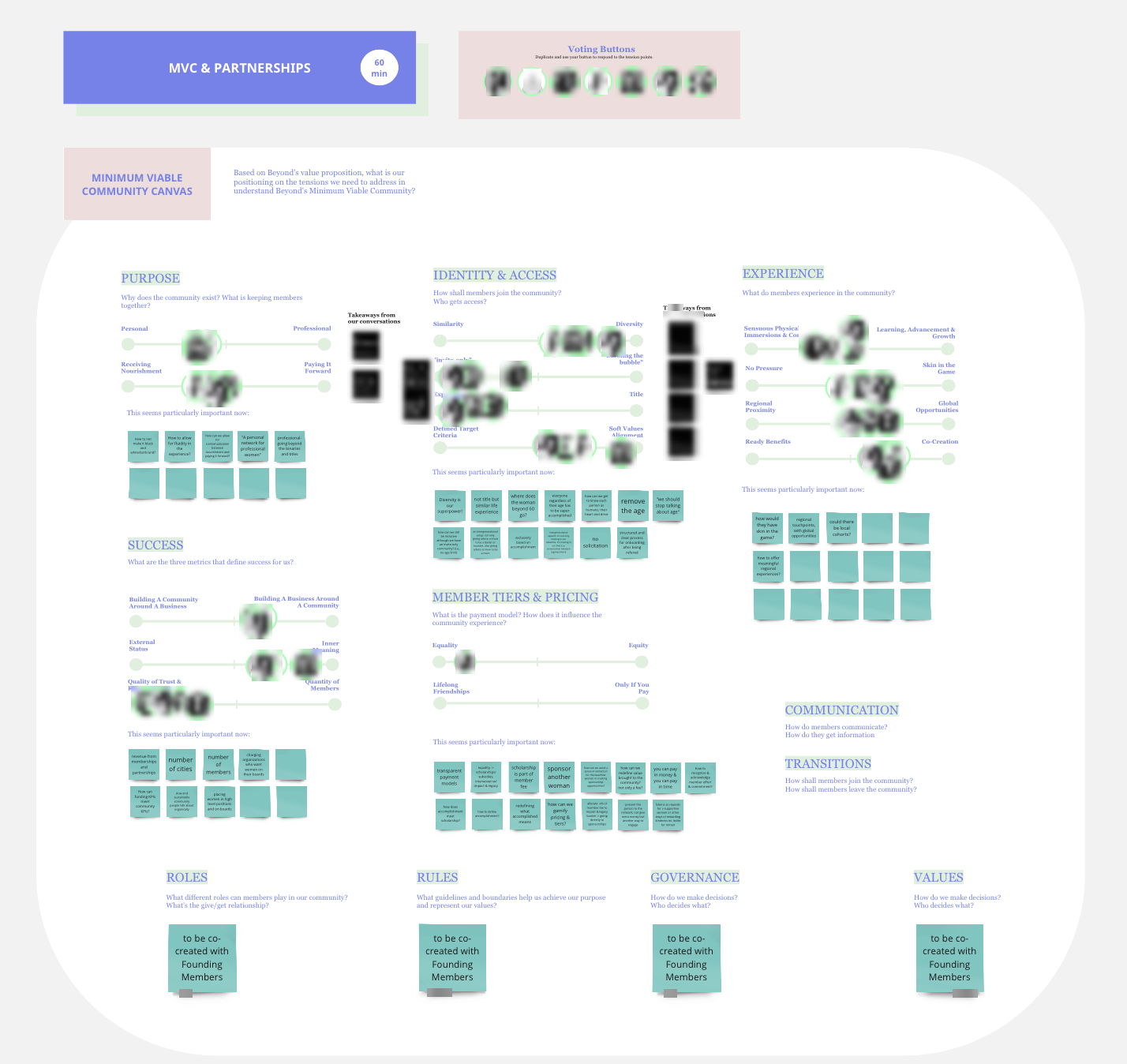
Purpose: personal or professional? Receiving nourishment or paying it forward?
Identity and access: similarity or diversity? Invite-only? Defined criteria or soft values alignment?
Pricing: equality or equity, and how do scholarships fit a premium model?
Success: quality of trust or quantity of members? External status or inner meaning?
Roles, rules and governance were deliberately left open, to be co-created with the founding members.
What we made
Positioning and narrative: who the community is for, why these women need it, and how it goes beyond, in its values, experiences and relationships.
Visual language and creative direction: a visual direction built from the Mandorla polarities, which set the look and feel for the brand guidelines and briefed the brand designer. Like the framework, the visual direction lives in the overlap: light and shadow, mystery and allusion, the softness and strength of natural forces alongside feminine movement.
Three MVP experiences, one per pillar:
Nourishment: a 1.5–2 day initiation retreat that builds ownership, trust and long-term commitment from day one.
Connection: targeted matching and themed, sponsored dinners across the region's hubs.
Growth: immersive online learning experiences, kept under 90 minutes and built to be applied, not just watched.
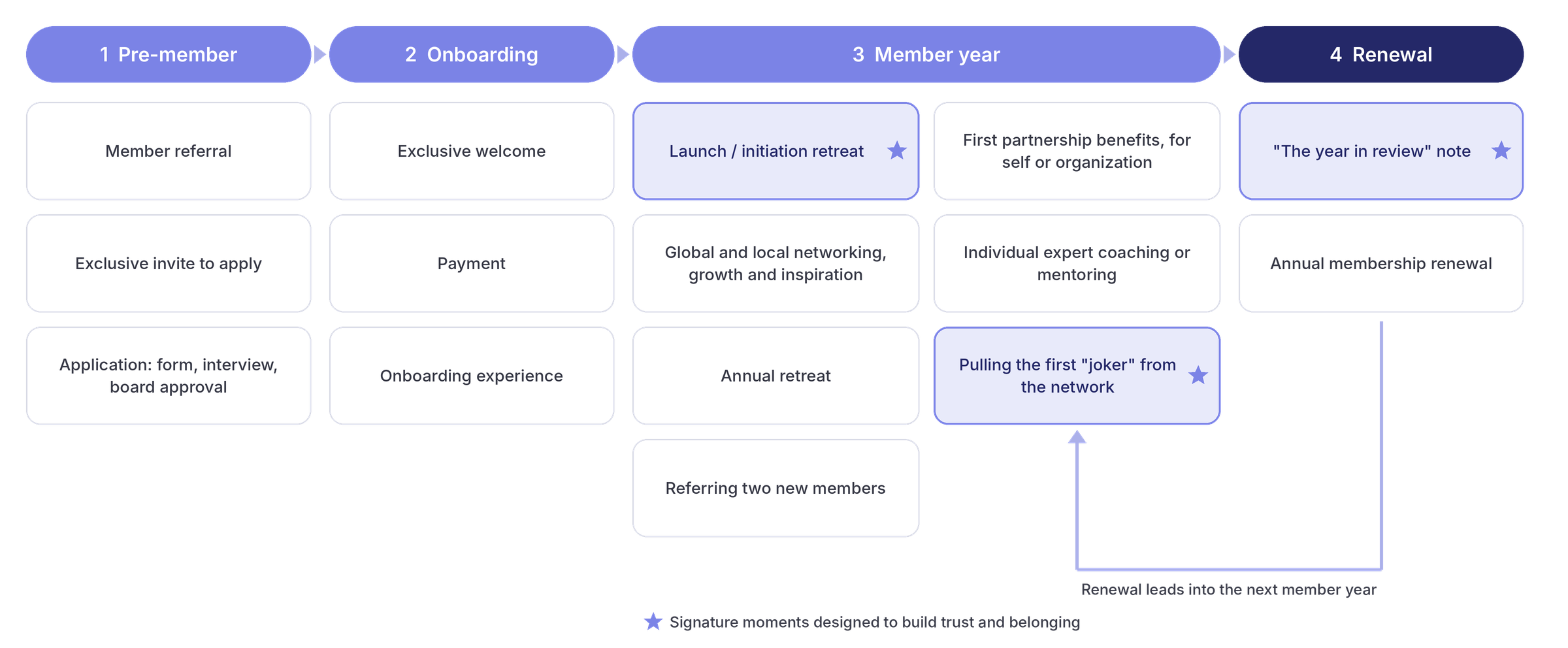
The member journey: from referral and an exclusive invite, through application, board approval and onboarding, to the initiation retreat, partnership benefits, networking and coaching, an annual retreat and renewal. Signature moments included "drawing a joker" (asking the whole network for one big favor, twice a year) and a personal year-in-review note.
A partnership map: potential partners for each pillar, from members' clubs to learning platforms.
Outcome
The research and framework anchored the community's brand strategy, membership journey and service pillars, and gave the founder a clear story for members, partners and investors.
The community launched in 2023 and now gathers members across the Gulf, Europe and the US, including during the World Economic Forum. The four service pillars from our research (Connection, Growth, Nourishment and Impact) are still its public pillars today, the visual language we set still carries the brand, and the community still describes its members in language that came straight out of the Mandorla work.
The women we spoke with seemed, at first, to come from distant edges of the world. Listening to them, I was reminded again how the need to belong, to be seen and heard wholly, is essential to all of us, and yet takes a specific shape in each person's context. These specificities are what we design for, so that community can flourish with purpose: in language, in experiences, in signature moments. That is why deep, human-to-human research matters to me: it's how you build something people recognize as their own.
Full case study available upon request.